Pentecost
Acts of the ApostlesPentecost, the Jewish harvest festival, becomes in Acts the decisive scene in which the Holy Spirit empowers Jesus’s followers to continue his ministry and bear witness to the Realm of God. The event joins harvest imagery to a beginning of human reunion: people divided by language come to understand one another, and a community takes shape without erasing the differences among its members.
Festival and End-Time Harvest
Pentecost was a Jewish holy day associated with the first fruits of the harvest. Exodus calls it “the festival of the harvest of the first fruits,” at the beginning of the wheat harvest. By placing the Spirit’s outpouring on this festival, Luke presents it as part of the harvest of the end times. The image belongs to a broader pattern in Luke’s writing, where the coming of the Realm is figured as a harvest: the festival setting makes the Spirit’s arrival not an isolated marvel, but a sign that the promised new age is beginning.
The Spirit already has a wide-ranging role in Israel’s Scriptures: present with God at creation, sustaining the world, filling people with awareness of God’s presence, and anointing them for particular tasks. End-time expectation adds a communal and public dimension. God would pour out the Spirit generously to strengthen communities through the last days and enable bold witness. The outpouring itself therefore signals the coming Realm.
The event also fulfills a promise traced through Luke and Acts. John the Baptist had announced that Jesus would baptize his followers with the Spirit expected in the last days. Jesus received an eschatological share of the Spirit and promised his disciples comparable empowerment. At Pentecost that promise comes true: the disciples are filled with the Spirit so they can continue Jesus’s ministry. For Luke, this empowerment assures beleaguered followers that they are on a faithful path, strengthens them to witness, and equips the church to extend its witness to gentiles.
A Community Formed by the Spirit
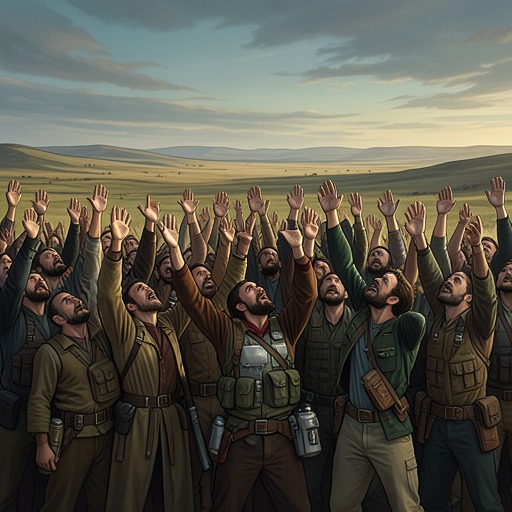
Luke emphasizes that the disciples are “all together in one place.” The Spirit’s arrival is communal from the outset, and the narrative presents the Spirit as the force that forms community, not merely as an individual experience. The sound is “like the rush of a violent wind.” The forceful description suits Luke’s end-time setting, understood as a period of conflict between the forces of God and Satan. As in the temptation of Jesus, the Spirit strengthens the community in a tense age and drives it toward witness.
Acts then shows the Spirit creating mutual understanding among Jewish people from many nations who have come to Jerusalem for the festival. The people hear and understand across their different languages and cultures; that shared understanding is itself a manifestation of the Realm. The narrative’s movement is from an event that commands attention to a diverse gathering capable of hearing one another, making community a visible consequence of the Spirit’s presence.
This gathering represents a beginning, not a completed universal reunion. At Pentecost, the people brought together are of Jewish origin or are proselytes. The circle will widen to include gentiles in the account of Cornelius. The sequence gives Pentecost a double significance: it inaugurates reconciliation across divisions while also opening toward a still broader community.
Diversity Without Erasure
Luke illustrates the gathering’s reach by naming residents associated with fifteen nationalities. Their presence makes the event larger than a local religious assembly: people with distinct homes, languages, and cultural identities participate in a shared experience. Under the Spirit’s power they become a community of mutual support, but they do not cease to be Parthians, Medes, or Elamites. Common purpose and values do not require cultural sameness.
The breadth of the list also carries a political implication. It includes peoples living beyond the Roman Empire, among them Parthians. Rome could maintain quiet within its borders through the Pax Romana and the force of arms, but it could not rule the whole world. Rome was often suspicious of and afraid of Parthia; in Luke’s scene, people from such rival territories are brought together by the Spirit. The Realm’s community crosses a boundary that imperial power could not overcome, and it does so through mutual understanding rather than the sword.
The story’s contrast with the scattering of peoples at Babel further clarifies what this reunion means. In Genesis, a united population builds a tower to make a name for itself, taking a role that belongs to the divine. God scatters the people and gives them different languages so they cannot repeat that error. In the old age, human communities remain contentious; end-time theologians look toward the reunion of the human family in the Realm. Pentecost pictures that reunion beginning, not by making everyone culturally identical, but by enabling people who remain different to understand and work with one another.
Interpretation and Narrative Place
The story of Pentecost includes the outpouring itself, its manifestation and initial response, and the opening of Peter’s sermon. Participants ask what the event means, a question that gives the scene its interpretive turn. The larger movement of Acts 2 presents a model of proclamation: an event draws attention, Peter interprets it theologically, and the gathered people respond. The account is thus concerned not only with extraordinary signs but with how a community makes sense of them and acts in response.
Peter interprets the experience through a modified version of Joel’s prophecy. In Luke’s presentation, the outpouring announces that the last days have arrived and that the Spirit will fall on all flesh, Jews and gentiles. The Spirit-filled community crosses social divisions as well: women and men, young and old, enslaved and free share the community’s prophetic vocation. The prophecy connects this inclusive witness with signs that will signal the approaching apocalypse and with the promise that those who call on God’s name will be saved and become part of the Realm.
Luke’s account then connects the Spirit’s arrival to Jesus. Jesus’s actions demonstrated the Realm; God raised him from the dead; and David, though dead, is presented as having recognized Jesus’s authority. Jesus is now at God’s right hand, and the argument culminates in the claim that God has made him Sovereign and Messiah. Most scholars regard Acts’ speeches as expressing Luke’s theology more than preserving the historical speakers’ exact words. Peter’s sermon therefore serves as Luke’s theological interpretation of Pentecost: the Spirit’s power, the community’s inclusive mission, and Jesus’s resurrection belong to one account of the Realm’s arrival.
Reception and Continuing Significance
Acts 2:1–21 is appointed for Pentecost in each year of the Revised Common Lectionary’s three-year cycle. Its boundaries include the event, the first response, and the beginning of Peter’s sermon, but the reading stops before the sermon’s argument is complete. A fuller presentation of Luke’s purpose would summarize Acts 2:22–36 and include 2:37–39, where repentance, baptism, and the gift of the Spirit show how God prepares the community for witness. Repeatedly hearing this passage can make Luke’s account seem like the single normative Christian interpretation of the Spirit; other New Testament writings offer additional perspectives, so the lectionary’s selections and possible supplements matter to how congregations understand the Spirit.
The story also challenges interpretations that reduce the Spirit’s work to private spiritual experience. In Luke, empowerment forms a community and directs it toward witness; the evidence of the Spirit’s presence includes people from different cultures understanding and supporting one another. The account therefore raises a concrete test for communities today: whether a diverse congregation’s practices actually make room for mutual understanding, or whether one culture’s values remain the unspoken norm. Pentecost’s significance lies not in difference disappearing, but in difference no longer preventing shared life and work in the Realm.